Using plant diversity to support sustainable development in Ethiopia
Ethiopia is both a biodiversity hotspot and ancient centre of crop diversity. We're working to document and conserve these species, enabling home-grown solutions to food security and sustainable development.

Project Status
Project lead
Department
Location
With a rich flora of ~6000 plants, Ethiopia has the second highest rate of wild plant endemism in tropical Africa and is the only sub-Saharan centre of plant domestication. These substantial Ethiopian plant assets represent opportunities for jointly delivering food security, socio-economic development and biodiversity protection.
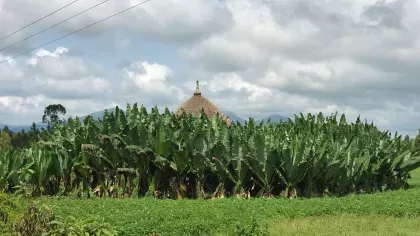
For example, Ethiopia has multiple endemic or underutilised crops (e.g., tef, noog, enset and yams), in addition to many useful yet poorly documented wild species that may hold the potential for enhanced nutrition, food system resilience, climate adaptation and income generation for rural communities.
The opportunity to deploy Ethiopia’s plant bioresources for addressing development challenges is rapidly diminishing as wild and agricultural plant diversity is lost to the conversion of natural habitats and homogenisation of agricultural landscapes. By drawing together a multidisciplinary team from both the UK and Ethiopia, and local stakeholders, this project aims to realise the potential of Ethiopia’s bioresources to enhance the inherent resilience of rural communities to social, economic and environmental stressors.
To do this, we will (i) make recommendations for protecting and effectively managing the diversity of wild and agricultural plants in designated Tropical Important Plant Areas (TIPAs), taking account of both socioeconomic and ecological considerations; and (ii) identify and characterise wild and agricultural plants with potential for improved nutrition, climate resilience and value chain development.
Pironon, S., Borrell, J.S., Ondo, I., Douglas, R., Phillips, C., Khoury, C.K., Kantar, M.B., Fumia, N., Soto Gomez, M., Viruel, J., Govaerts, R., Forest, F. & Antonelli, A. (2020)
Toward unifying global hotspots of wild and domesticated biodiversity
Plants 9: 1128. https://doi.org/10.3390/plants9091128.
Darbyshire, I., Anderson, S., Asatryan, A., Byfield, A., Cheek, M., Clubbe, C., Ghrabi, Z., Harris, T., Heatubun, C.D., Kalema, J. and Magassouba, S. (2017)
Important Plant Areas: revised selection criteria for a global approach to plant conservation
Biodiversity and Conservation 26: 1767-1800. https://doi.org/10.1007/s10531-017-1336-6.
Jago, S., Elliott, K.F.V.A., Tovar, C., Soto Gomez, M., Starnes, T., Abebe, W., Alexander, C., Antonelli, A., Baldaszti, L., Cerullo, G. and Cockel, C. (2024)
Adapting wild biodiversity conservation approaches to conserve agrobiodiversity
Nature Sustainability 7, 1385–1394. https://doi.org/10.1038/s41893-024-01427-2.
Addis Ababa University
University of Greenwich
University of East Anglia
Gullele Botanic Garden
Ethiopian Biodiversity Institute
Supported by
-
The Global Challenges Research Fund (GCRF) – UK Research and Innovation

Read more