Landscape patterns of local adaptation in Ethiopian crops
Comparing local adaptation in introduced and indigenous crops, to support food security and climate resilience

Project Status
Project lead
Department
Location
Ethiopia has historically been the world's largest recipient of targeted food aid. However, little food-insecurity has been reported for the southern Ethiopian highlands, even during the devastating famines of the 1980s. Today, the agri-systems of the southern Ethiopian highlands successfully support one of the highest rural population densities in Africa (up to 1000 persons/sq km).
We are investigating the landscape scale dynamics, interactions and resilience of these agri-systems using interdisciplinary environmental modelling, crop genomics and natural capital approaches. In turn, this will inform how best to manage the response of these agri-systems to climate change whilst continuing to provide food security for a growing Ethiopian population.
Ethiopia is a critically important centre of diversity for food crops. Southern Ethiopian agri-systems include more than 78 cultivated species encompassing roots, tubers, cereals, vegetables, fruits and pulses, including a very high proportion of indigenous crops. Typical farms average 19 different crop and livestock species underpinned by over 120 species of useful trees and shrubs co-occurring across the homegarden landscape, despite an average farm size of less than a hectare.
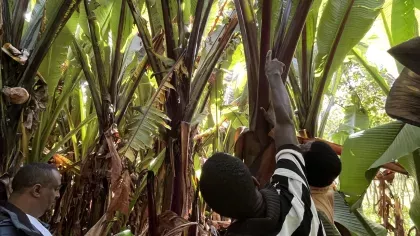
Kew’s research on individual crop species also indicates extremely high diversity. For example, we have recorded >600 named enset varieties, including up to 24 on a single farm, and 37 varieties of yam. This diversity aggregated at multiple scales may be the key to the past resilience of the southern Ethiopian highlands in times of famine, and the source of future resilience to climate change.
Working together with colleagues at Queen Mary University of London and the Natural Resources Institute at the University of Greenwich, this project builds on Kew's long-standing collaboration with researchers in Ethiopia, partnering with Addis Ababa University, Hawassa University and the Ethiopian Biodiversity Institute.
Rampersad, C., Geto, T., Samuel, T., Abebe, M., Gomez, M.S., Pironon, S., Büchi, L., Haggar, J., Stocks, J., Ryan, P. and Buggs, R.J. (2023)
Indigenous crop diversity maintained despite the introduction of major global crops in an African centre of agrobiodiversity
Plants, People, Planet 5(6), pp.985-996. https://doi.org/10.1002/ppp3.10407
Morrow, N., Borrell, J. S., Mock, N. B., Büchi, L., Gatto, A., & Lulekal, E. (2023)
Measure of indigenous perennial staple crop, Ensete ventricosum, associated with positive food security outcomes in southern Ethiopian highlands
Food Policy, 117, 102451. https://doi.org/10.1016/j.foodpol.2023.102451
Queen Mary University of London
Natural Resources Institute
University of Greenwich
Addis Ababa University
Ethiopian Biodiversity Institute
Supported by
-
UKRI BBSRC

Read more
Protecting the future with Ethiopia's endangered crops
