Today's Flora for Tomorrow (Madagascar)
Give digital access to and work towards the conservation of plants and fungi of Madagascar while training the next generation.
Project Status
Project lead
Department
Location
The biodiversity crisis is one of the most urgent global challenges, threatening ecosystems, livelihoods, and long‑term sustainability. To protect nature effectively, we must first understand it. Yet many plant and fungal species remain poorly known or unnamed, and gaps in taxonomic knowledge hinder conservation, sustainable use, and environmental planning.
In Kew Science, we aim to address this problem by creating faster, more reliable ways to identify plant and fungal species. The Today’s Flora for Tomorrow project is a key part of this effort, tackling the urgent need for accessible, high‑quality biodiversity information—especially for Madagascar, one of the world’s most threatened biodiversity hotspots.
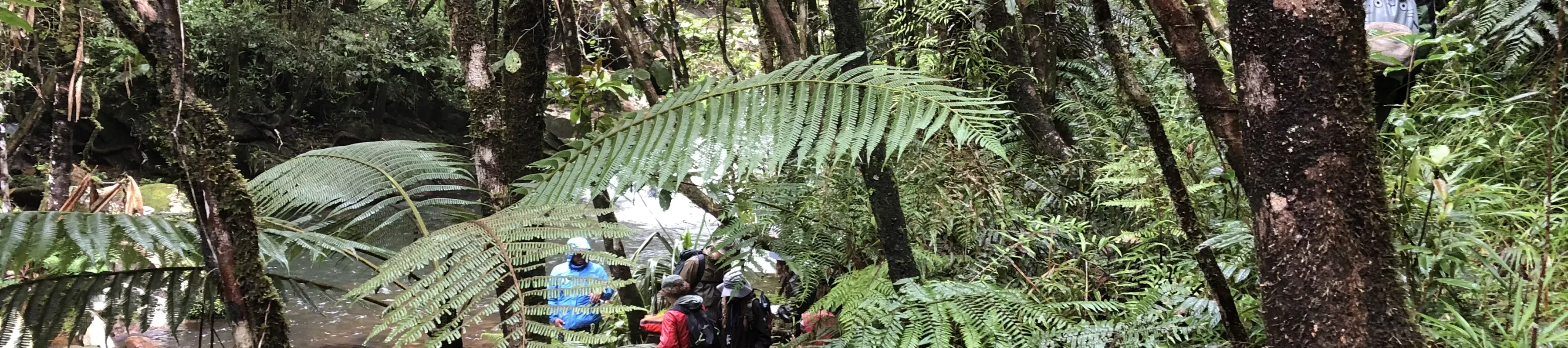
To drive change, the project is digitising and making available thousands of preserved botanical specimens held at Kew and at the Parc Botanique et Zoologique de Tsimbazaza (PBZT). This work provides open access to critical data for researchers, conservationists, and decision-makers. The team is also conducting IUCN Red List assessments to support evidence‑based conservation action, with a current focus on species from the Itremo Massif Protected Area. Field expeditions to understudied regions are generating new biodiversity data to fill longstanding knowledge gaps.
A major component of the project is capacity building. By training emerging Malagasy experts in plant and fungal taxonomy, the project strengthens long‑term national capability for biodiversity conservation. This includes pioneering fungal research by postdoctoral researcher Anna Ralaiveloarisoa, as well as three PhD projects on orchids, sedges, and succulent plants.
Ultimately, the project aims to accelerate species description and identification, inform conservation priorities, and build lasting scientific expertise in Madagascar—ensuring that today’s biodiversity knowledge becomes tomorrow’s foundation for protecting and restoring nature.
Rasaminirina F, Wieczorkowski JD, Rakotoarimanana V, Rafaralahy VL, Rakotonirina N, Ralimanana H, Larridon I (2026)
Patterns of composition, richness and endemicity of Cyperaceae across open and closed habitats in Madagascar's Central Highlands.
Biotropica. https://doi.org/10.1111/btp.70160
Arno J, Morel J, Rasaminirina F, Maciel-Silva JF, Little DP, Silvestro D, Antonelli A, Grace O, Zhang L, Larridon I (2025).
A pipeline to compile expert-verified datasets for automated plant identification to accelerate taxonomy.
Plants People Planet: https://doi.org/10.1002/ppp3.70149
Rakotonasolo F, Rajaovelona LR, Rakotoarisoa AA, Rasaminirina F, Rakotomalala NH, Andry AM, Razafiniary V, Razanajatovo H, Randriamamonjy N, Randrianasolo V, Nanjarisoa OP, Rakotoarisoa SE, Rajaonah MT, Randriamboavonjy T, Rabehevitra D, Onjalalaina GE, Rabarijaona RN, Rahaingoson FR, Cable S, Larridon I, Ralimanana H (2025)
The Itremo Massif Protected Area in the Central Highlands of Madagascar – a plant species checklist.
Kew Bulletin 80: 323–335. https://doi.org/10.1007/s12225-023-10147-3
Rasaminirina F, Larridon I (2023)
The genera of Cyperaceae of Madagascar.
Plant Ecology and Evolution 156(3): 276-310. https://doi.org/10.5091/plecevo.98847
Project Leaders
Team
Velosoa Razafiniary
Anna Ralaiveloarisoa
Andrianina
Webber
Jaonasy Liantsoa Rakotoarimino
Hanta Vololona Razafindraibe
Kantosoa Rasoanomenjanahary Fehizoro
Rindah Randriambololona
Parc Botanique et Zoologique de Tsimbazaza, Madagascar University of Antananarivo, Madagascar
Supported by
-
Kew Development