8 May 2025
5 min read
Exploring the magic of trees
Discover the ancient folklore and myths behind oaks, yews and many other trees.

Trees are incredible.
They provide us with food and shelter, play a key role in our ecosystems and are ancient sentinels of our landscapes across time and space.
And we can’t forget that they’re responsible in part for the air we breathe.
It’s no wonder we have loved and celebrated trees for millennia. They’ve formed a key part of our mythologies, culture and folklore.
As we celebrate trees at Kew Gardens this summer, explore the magic and mysticism behind some of our favourite trees.
The mythology of oak trees
One of most common native trees in the UK, the English oak (Quercus robur) is nothing short of an icon.
They can live for over a millennium and reach nearly 40 metres in height, so it’s no wonder that these titanic trees have become staples of myth and legends.
Their height might be part of the reason they are commonly associated with gods of thunder and lightning. Oak trees were considered sacred to Zeus in ancient Greece, Jupiter in ancient Rome, and Thor in Norse mythology.


But it’s in Celtic mythology where the oak is a true crown jewel.
Ancient Druids revered the oak as a holy symbol of the Dagda, one of the highest gods of the Celtic pantheon. They also collected mistletoe grown in the upper branches of oak trees using golden sickles.
In fact, it’s thought that the word “druid” originates from a root word meaning oak.
Today, the oak continues to feature in modern iconography, such as the logo for both the Woodland Trust and the National Trust.

Yew tree folklore
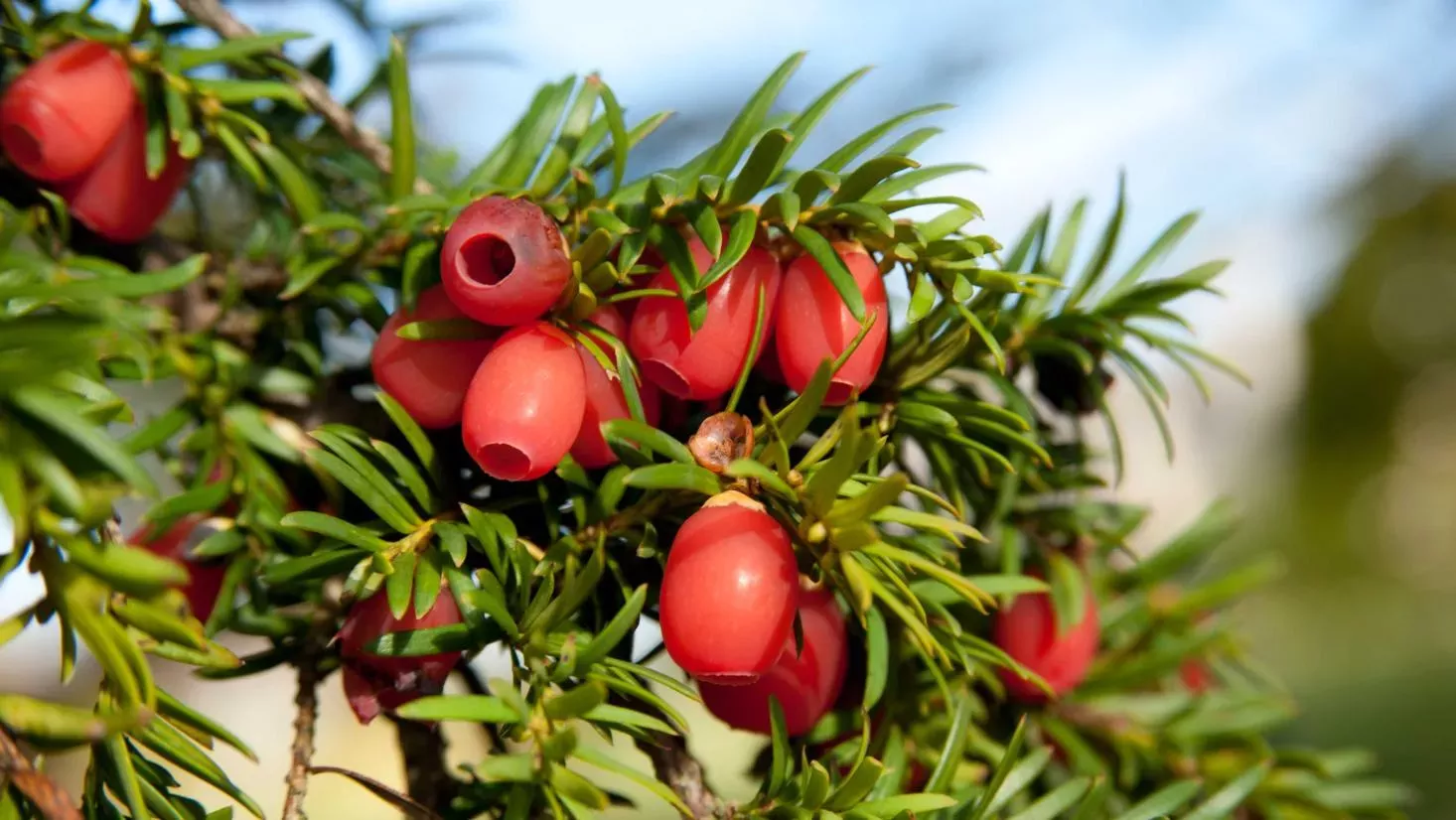
Alongside the oak, the yew tree (Taxus baccata) is a familiar sight all over the UK.
With their dense growth of needles and branches, yews are very popular for natural fencing and shaping into topiary.
But they’re also often found in graveyards and around churches, lending them the name “the tree of the dead”.
Why are yew trees planted in graveyards? In pre-Christian Britain, the yew tree was considered a symbol of death and resurrection by Celtic druids. As Christianity spread across the country, churches and graveyards would often be built on sites where yew trees already grew, to help bring people more easily into the new religion.

Yew trees and longbows
The tree of death is not only well named because it’s found in graveyards, however.
The flexible wood from yew trees was highly prized in medieval times for creating the powerful longbows that helped English soldiers win countless battles. In some European countries, kings placed monopolies on the number of yews that could be cut down due to how popular they were.
Yew wood was so popular for bow-making that in Norse mythology, the bow god Ullr was said to live in a grove of yew trees.
Incredibly, the yew tree is also linked to death in a third way: almost every part of the tree is poisonous if consumed.

The trees that hold up the world
One of the most famous mythological trees is the world tree Yggdrasil, found in Norse mythology.
This tree is described as a colossal ash tree (Fraxinus excelsior) which exists at the centre of the universe, with the nine worlds around it. The Norse gods, the Æsir, were said to meet at Yggdrasil each day to discuss politics.
The tree was also home to several mythological creatures, including a hawk named Veðrfölnir in its branches, a squirrel named Ratatoskr along its trunk and a dragon named Níðhöggr that gnawed at its roots.
But the concept of a world tree isn’t just limited to Norse mythology. The Maya represented the world tree with a ceiba tree, which is a cousin of the cacao, or cocoa, tree. In both Baltic and Slavic mythology, the world tree is represented as a giant, upside down oak tree. And in Eurasian mythology, the world tree was called the “golden poplar” and had a two headed eagle nesting in its crown.


Trees in the Garden of Eden
In Christian and Jewish tradition, there’s no more infamous snack than the forbidden fruit eaten by Adam and Eve in the Garden of Eden.
Persuaded by a snake who was possibly the devil, Eve takes a bite of a piece of fruit that provides her with knowledge of good and evil. After sharing with Adam, they are banished from paradise by their god.
You’ve probably seen this rendered in artworks as an apple, but there’s actually a lot of discussion among historians as to exactly what the fruit was.
Some suggestions include fig (Ficus carica), grape (Vitis vinifera), pomegranate (Punica granatum), and even a head of wheat (Triticum aestivum)!
Alongside the knowledge-giving tree, the Garden of Eden was also said to contain a tree with fruit that would give eternal life to anyone who ate it.


The sacred fig
Found in the Indian subcontinent, the sacred fig (Ficus religiosa) is an icon for four religions: Buddhism, Hinduism, Jainism and Sikhism. As it can live for hundreds of years, it is often linked to longevity of life.
In Buddhism, Siddhartha Gautama is said to have gained enlightenment as he sat meditating beneath a sacred fig. As a result, the tree became known as the “bodhi” tree, a word meaning enlightenment. While the original tree was destroyed in 1876, a direct descendent still grows at the Mahabodhi Temple in India.
In Hindu tradition, people will walk in a clockwise direction around scared fig trees in a practice known as parikrama. The tree is known as Aśvattha, as is said to represent the totality of the universe.
Outside of religious importance, the sacred fig is also used in traditional medicines as a treatment for asthma, diabetes and stomach pain.


Read & watch