Supporting climate-resilient sustainable development in Africa
Realising the potential of plants as nature-based solutions in African biodiversity hotspots, supported by the Global Center on Biodiversity for Climate.

Project Status
Project lead
Department
Location
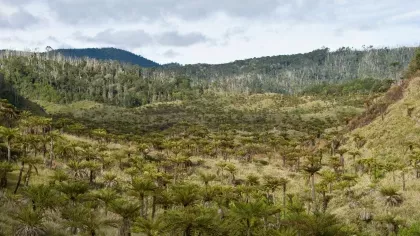
This project aims to characterise the value of plant biodiversity hotspots by analysing the ecosystem service provisioning of these hotspots, in Ethiopia, Guinea and Sierra Leone. Centred on the application of the Important Plant Areas approach and the Kew Tropical Important Plant Areas (TIPAs) programme, this project focuses on in situ conservation and community-based sustainable use and management of wild and agricultural plant bioresources. The ultimate goal, is to positively impact lives, livelihoods, biodiversity, ecosystems, and climate resilience.
Plant Life International established the Important Plant Areas (IPAs) system of identifying sites of global importance for plant biodiversity. This provides policy makers with a user-friendly and effective method of assessing plant diversity to better inform conservation and land-use policy, and to prioritise conservation in the areas that contain both globally threatened species and habitats, and/or sites of exceptional botanical richness.
Although areas of botanical richness are not restricted to tropical areas, exceptional species richness is consistently associated with tropical biomes. They provide a barely tapped resource for technological innovations, including but not limited to, medicine, agriculture, food security, water use, and climate resilience in the face of climate change. Therefore, documenting and conserving it, is of utmost importance so that we can protect future applications to our own well-being.
Kew, together with local in-country partners has been focused on documenting TIPAs across the globe since 2015, and this project aims to fill gaps in our documentation of species occurrence and TIPAS of the African continent. By completing the identification of tropical important plant areas (TIPAs) in Ethiopia, Guinea, and initiating identification in Sierra Leone, these areas can be prioritised for in-situ conservation and sustainable utilisation. Moreover, documenting the co-benefits for people of conserving TIPAS.
Jago, S., Elliott, K.F.V.A., Tovar, C., Soto Gomez, M., Starnes, T., Abebe, W., Alexander, C., Antonelli, A., Baldaszti, L., Cerullo, G. and Cockel, C. (2024)
Adapting wild biodiversity conservation approaches to conserve agrobiodiversity
Nature Sustainability 7(11), pp.1385-1394. https://doi.org/10.1038/s41893-024-01427-2.
Project Leaders (Co-principle investigators)
Carolina Tovar (Phase 2 Project Leader; Phase 1)
Iain Darbyshire (Phase 2; Phase 1 Project Leader)
Olwen Grace (Phase 1 Project Leader)
James Borrell (Phase 2 Project Leader; Phase 1)
Project Coordinators
Charlotte Couch (Phase 2; Phase 1)
Kelda Elliott (Phase 2; Phase 1)
Team members
Kew Science
Amy Barker (Phase 1)
Steven Bachman (Phase 2; Phase 1)
Martin Cheek (Phase 1)
Moabe Fernandes (Phase 2)
Garbriella Hoban (Phase 2; Phase 1)
Sophie Jago (Phase 2; Phase 1)
Joseph Langley (Phase 2)
Isabel Larridon (Phase 1)
Felix Lim (Phase 1)
Henry Miller (Phase 2)
Eimear Nic Lughadha (Phase 2, Phase 1)
Timothy Pearce (Phase 1)
Jack Plummer (Phase 2; Phase 1)
Seth Ratcliffe (Phase 2, Phase 1)
Alexandra Roberts (Phase 2; Phase 1)
Harry Smith (Phase 1)
Vida Svanström (Phase 2; Phase 1)
Joseph White (Phase 2, Phase 1)
Paul Wilkin (Phase 1)
China Williams (Phase 2)
Volunteers
Lynda Murrary (Phase 2; Phase 1)
Jenna Willis (Phase 2; Phase 1)
University of Addis Ababa, Ethiopia & the National Herbarium of Ethiopia
Sebsebe Demissew
Ermias Lulekal
Sileshi Nemomissa
Bezawit Genanaw (Phase 1 intern)
Tesfanesh Ashagre (Phase 1 intern/ Phase 2 RL Workshop Participant)
Hanny Solomon (Phase 1 intern)
Ethiopian Biodiversity Institute
Feleke Woldeyes
Efrata Waldearegay (Phase 1 intern/ Phase 2 RL Workshop Participant)
Hawassa University, Ethiopia
Wendawek Mangesha
University of Gamel Abdel Nasser, Guinea & The National Herbarium of Guinea
Sékou Magassouba
Denise Molmou (Phase 1 intern)
Tokpa Seny Dore (Phase 1 intern)
Nagnouma Conde (Phase 1 intern)
Guinee Ecologie
Mamadou Diawara
Centre Forestiere Nzerekore, Guinea
Leonce Mamy
University Of General Lansana Conte Sonfonia, Guinea
Mamadi Camara
Jonathan Johnny (Phase 1 intern)
Momoh Sesay (Phase 1 intern)
Samuel Sokpo (Phase 1 intern)
Njala University, Sierra Leone & The National Herbarium of Sierra Leone
Aiah Lebbie
The Alliance of Bioversity and CIAT
Adam Drucker
The non-Kew collaborators listed are direct collaborators of the project; but we do have other organisations working with us via our direct collaborators.
We are also open to developing new collaborations during the duration of the project. If you are interested in becoming a collaborator, please email James Borrell (j.borrell@kew.org) and Carolina Tovar (c.tovar@kew.org). Thank you!
Supported by
-
Global Centre on Biodiversity for Climate (DEFRA)


Tropical Important Plant Areas (TIPAs) in Sierra Leone

Tropical Important Plant Areas (TIPAs) in Guinea-Conakry
Read more

Climate change resilience in southern Ethiopian crops
Guarding Guinea’s biodiversity