Spirit Collection
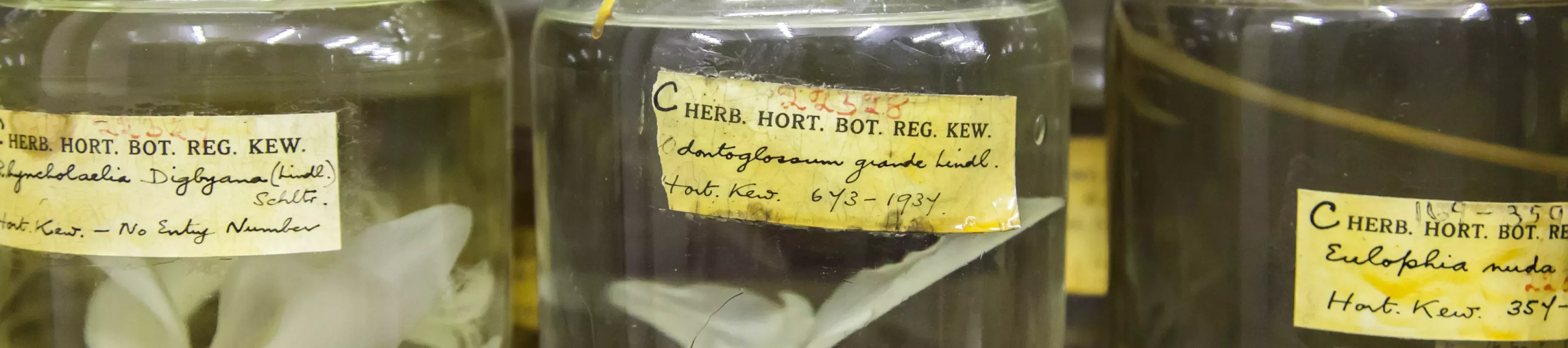
Our Spirit Collection consists of over 78,000 plant specimens preserved in fluid and stored in glass jars.
Our new Data Portal is LIVE! You can now explore selected records from the Spirit Collection at the click of a button.
About our Spirit Collection
The collection is rich in diversity, with more than 370 families represented and including 1,600 types. Our Spirit Collection is probably the largest botanical spirit collection in the world, it is also one of the world’s largest and most diverse collections of orchids in spirit. The collection also houses the mycology spirit collection which contains more than 1,250 specimens with representatives from many genera.
Preserving specimens
Spirit preserved material is used where drying, pressing and mounting on a herbarium sheet is unsuitable, particularly where observation of the three-dimensional arrangement of flower parts or fruits are required.
Fluid preservation is the chemical stabilisation of tissue to prevent autolysis. Fixation is used to prevent post mortem changes in the specimen, to stop cells breaking down after death. The fixative forms covalent bonds between molecules. Preservation refers to the maintenance of the specimen in a stable and usable condition by inhibiting enzymatic and microbial attack.
History of the collection
The Spirit Collection was started in 1930 by Victor Summerhayes, who was a curator of the Orchid Herbarium at the time. The existing specimens were incorporated into one collection; some date as far back as the 1830s and include a number of specimens collected in India in the 1850s by former Director of Kew, Sir Joseph Dalton Hooker.
Curation
The Spirit Collection is housed in a purpose-built, temperature-controlled store fitted with mobile banks of metal drawers to maximise storage. The larger jars (2,000 and 3,000ml) are stored on fixed metal shelving in enclosed cupboards to reduce the impact of UV light. Jar sizes range from 70ml to 3,000ml, with some out-sized jars for specimens such as the flowers and fruits of Aristolochia grandiflora and Musa lolodensis.
The collection is maintained at between 12–15°C and 50% humidity: this temperature reduces evaporation and lowers the likelihood of fire. Adjacent to the store is a laboratory, where spirit specimen preparation work (including topping up and preparing new accessions from the Living Collection) is carried out.
The collection is arranged in specimen number order, according to jar size. This non-systematic arrangement removes the need to continually re-arrange the collection according to revisions and maximises storage.
Use of the collection
Many specimens in the Spirit Collection have associated herbarium sheets, carpological material and DNA voucher specimens in the Herbarium and Jodrell Laboratory. The collection continues to grow with material incorporated from overseas fieldwork and from our Living Collection.
The collection is used mainly for taxonomic research by staff and specialists from around the world. But it is also a valuable source of material for non-taxonomic research, and as such is used by a wide range of scientists, artists and students.
Many specimens have been used for botanical illustration, as spirit material retains a life-like appearance and have appeared in Curtis's Botanical Magazine.
Access to the collections
Kew’s Data Portal is the primary gateway to explore our collections, bringing together records of millions of specimens in one searchable platform. The previous Herbarium Catalogue (HerbCat) has now been fully integrated into the Data Portal, where users can search by plant name, collector, country, and more.
The Spirit Collection comprises over 78,000 specimens, all of which have been digitised and can be explored through the Data Portal. Although these records are not all imaged, the Spirit Collection remains accessible to academic visitors upon request and to the public during special events such as open days. Selected specimens may also be displayed in the Herbarium reception or featured in Library reading room exhibitions.
Contact via the Herbarium
Herbarium
Royal Botanic Gardens, Kew
Richmond
TW9 3AE
UK
Email: herbarium@kew.org
Discover more
Science Collections Strategy