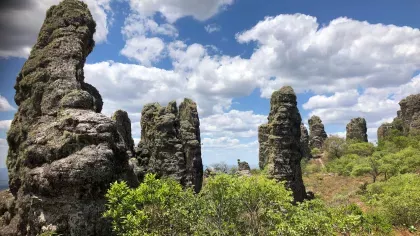
Important plants for the world in the centre of South America
10 years of Mapping the Green Heartland - Bolivia’s Important Plant Areas (IPA) – Prioritising Endemic, Threatened, and Useful Plants and Habitats for protection and sustainable use

Project Status
Project lead
Department
Location
Bolivia, a botanically megadiverse country, host 16,000 native wild plant species, 2,661 of which are endemic to the country. Moreover, Bolivia is a centre of origin of many food crops such as bell peppers, chilli peppers, beans, potatoes, tomatoes, peanuts, quinoa and yucca with over 200 wild relatives of these important crops, and 3,300 useful native plant species.
The Royal Botanic Gardens, Kew have partnered with Bolivia for 30 years, with the current project existing for ten years (2016̶ ). Our work includes botanical research, extensive field studies, developing in-country research capacity, and active engagement with conservation professionals and policymakers.
The overarching objectives are to: a) document and promote conservation and sustainable use of Important Plant Areas (IPA) in Bolivia, b) assist the country in developing its strategy for the protection and sustainable use of its plant diversity, and c) support Bolivia in meeting its commitments under the United Nations Convention on Biological Diversity (CBD) by providing practical, accessible tools and resources for policymakers.
Bolivia is the first South American country to possess a network of Important Plant Areas (IPA). The Bolivian IPA network comprises 87 sites covering 406,071 km2, of country’s total area (1,098,581 km2). We applied the Important Plant Areas (IPA) criteria. These are rigorous, internationally recognised standards to identify sites of national and global importance for the protection and sustainable use of plants.
Of the 87 IPA sites, 74 exactly match or overlap 10-75 % with legally recognised protected areas such as National Parks, Key Biodiversity Area (KBA), or RAMSAR wetland sites. However, despite the well-protected IPA sites, 13 IPA lack any form of legal protection.
IPA site assessments are supported by IUCN’s Red List of globally threatened species. Here, we have provided extinction risk assessments for 732 endemic Bolivian species, their Red List status published on the IUCN Red List. Yet to date, only 33% (899) of Bolivia’s 2,661 endemic species have an IUCN red list status. On the upside this project documented that the 87 IPA sites collectively contain 1,909 (79%) of Bolivia’s 2,661 endemic plant species and 3,255 (90%) of it useful native plants.
In 2026, we published the book “Important Plant Areas in Bolivia - Endemic, threatened, and useful plants and priority habitats in central South America ̶ a community effort of 36 botanical experts, representing 19 botanical institutions, majority Bolivian.
In-country capacity development for IUCN and IPA methodology has been our priority, resulting in: a) 22 Bolivian professionals certified as Red List conservation assessors and the first Spanish-speaking certified IUCN trainer certified; b) training 45 undergraduate and Master’s Biology students in the IUCN and IPA methodology; c) providing one-year scholarships and supervision for six undergraduate thesis projects; and d) organising and delivering numerous training sessions and workshops for stakeholders.
Ministerio de Medio Ambiente y Agua (MMAyA) (2020)
Libro Rojo de Plantas Amenazadas de las Tierras Bajas de Bolivia
Editorial Fundación Amigos de la Naturaleza, Santa Cruz.
Villarroel, D., Parada, G.A., Martinez-Ugarteche, M.T., Klitgaard, B.B. (2022)
Handroanthus abayoy, a new species of Bignoniaceae endemic to Bolivia
Phytotaxa 547(1): 97-104.
Martinez-Ugarteche, M.T., Toledo, M., Klitgaard, B.B. (Invited editors) (2023)
Número Especial Programa TIPAs Bolivia
Kempffiana 19(2): 1-360.
Klitgaard, B.B., Martinez-Ugarteche, M.T., Villarroel, D., Toledo, M. (2023)
Guía para la aplicación de criterios TIPAs (Áreas Tropicales Importantes de Plantas) en Bolivia, modelo de estudio en la ecorregión del Bosque Seco Chiquitano, Santa Cruz
Kempffiana 19 (2): 1-17.
Villarroel, D., Lino-Villalba, O.A., Arroyo-Herbas, L., Klitgaard, B.B. (2025)
A new species of Myrciaria and botanical novelties in the family Myrtaceae for Bolivia
Phytotaxa 701 (3): 261-270.
Fundación Amigos de la Naturaleza (NGO), Santa Cruz de la Sierra, Bolivia
Oxford University, United Kingdom
Museo de Historia Natural, Noel Kempff Mercado, Universidad Autonoma Gabriel Rene Moreno, Santa Cruz, Bolivia
Herbario Nacional de Bolivia, Universidad Mayor de San Andrés, La Paz, Bolivia
Herbario Forestal Martín Cárdenas, Universidad Mayor de San Símon, Cochabamba, Bolivia
Herbario del Sur, Facultad de Ciencias Agrarias, Universidad San Francisco Xavier de Chuquisaca, Sucre, Bolivia
Missouri Botanical Garden, St. Louis, U.S.A.
Supported by
-
The Darwin Initiative

-
The Peoples’ Postcode Lottery

-
The William A. Cadbury Trust
-
The Bentham Moxon Trust

-
The Ingram Trust
-
The Emily Langley-Metcalfe Trust
-
The Robert & Jenny Akester Trust

Tropical Important Plant Areas (TIPAs)
Read more
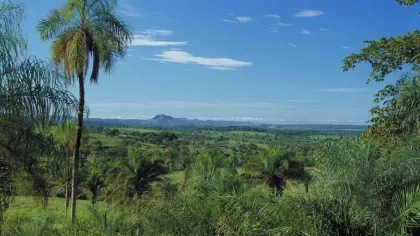
The Chiquitania: Tropical Important Plant Areas in Bolivia
Documenting Bolivia's bountiful botany