Tropical Important Plant Areas (TIPAs) in Indonesian New Guinea
Identifying Tropical Important Plant Areas to protect island megadiversity

Project Status
Project lead
Department
Location
The West Papuan stakeholder driven Manokwari Declaration has set one of the planet’s most ambitious conservation targets to protect 70 % of land area on the planet’s most plant species-rich island. The Manokwari Declaration offers a framework for sustainable development and this project aims to provide the botanical evidence basis to inform planning decisions.
Important Plant Areas (IPAs) offers a practical but rigorous means of identifying site-based conservation priorities. IPAs are aligned to Target 5 of the CBD’s 'Global Strategy for Plant Conservation' and so offer an important step towards fulfilling national CBD targets.
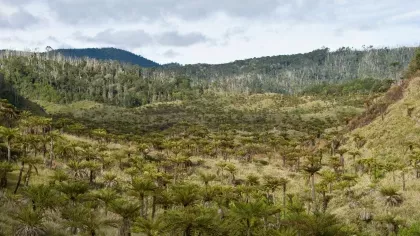
The tropical island of New Guinea has a large area of intact habitats remaining and has been designated as one of the three remaining tropical Wilderness areas by Conservation International. This project is part of Kew’s Tropical Important Plant Areas (TIPA) programme and with in-country partners, especially Badan Riset Inovasi Daerah and Universitas Papua, is identifying important plant areas in Indonesian New Guinea focused on the Bird’s Head Peninsula.
Kew has been actively working in New Guinea and has undertaken many expeditions to the Indonesian side of the island as well as Papua New Guinea. Kew has developed a comprehensive database of all the collections of several families and will be expanding this across a range of ecologically important plant groups. Kew staff are naming, databasing and georeferencing all incoming material of these groups. Kew and partners are undertaking workshops, training, expeditions and community work across the Bird’s Head Peninsula.
Objectives:
Provide an evidence basis for conservation planning in the Bird’s Head.
Compiling a list of West Papuan plant species and a georeferenced dataset of all known specimens.
Producing full Red List assessments for West Papuan endemic species.
Avoiding extinction of Indonesian New Guinea’s endemic, threatened and socio-economically important plant species through inclusion in Important Plant Areas with national and/or community protection, complementing the future development plan of West Papua Province which has been designated as Indonesia’s first conservation province.
Consultative capacity building workshops on a range of subjects with partners in New Guinea, providing data and expertise needed to inform selection of protected areas. Training to include plant identification, red-listing, seed-banking, ethnobotany
UNIPA (Universitas Papua), Manokwari, Indonesia; BRIDa (Badan Riset dan Inovasi Daerah) Papua Barat, Plantlife International
Supported by
-
Private Donation; Bentham Moxon Trust; Research Collaborations grant, ID 1203539608, under the International Science Partnerships Fund. The grant is funded by the UK Department for Science Innovation and Technology in partnership with the British Council
Read more

The palms of New Guinea
Trees of New Guinea