11 February 2026
5 min read
The women behind Nature Unlocked
Meet the women working on Wakehurst's landscape ecology programme.

International Day of Women and Girls in Science is an opportunity to shine the spotlight on women working in STEM (Science, Technology, Engineering and Maths) roles.
This year, Wakehurst is celebrating a year of 'connecting to nature', a theme woven throughout the projects and events across the landscape. Nature Unlocked aims to inspire a deeper understanding of the role nature plays, fostering a passion to protect it.
Discover the stories of some of the women behind Nature Unlocked, turning Wakehurst's diverse landscapes into a living laboratory.
Eliana van der Schraft, Citizen Science Lead
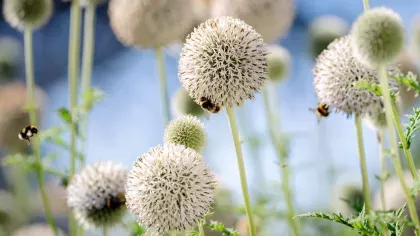
Eliana leads the citizen science projects within Nature Unlocked, engaging communities with Wakehurst's science and horticulture. She does this by coordinating Trees for Bees with pollination scientist Dr Janine Griffiths-Lee. This project aims to find out which trees our native pollinators like best so we can make our cities more friendly for them. She helps visitors to become citizen scientists by watching and counting pollinators on trees around the gardens, and supporting our conservation efforts. This work provides Janine with vital data.
It is a privilege to introduce new people to Wakehurst and allow them to contribute to the science we are doing here, as it can often feel out of reach for people. Science is typically associated with lab coats and advanced degrees, and while this is sometimes true, really it is about curiosity. Living in the world and being curious about ‘the what’ and ‘the how’ that surrounds you, and helping others make that connection is incredibly fulfilling.

Dr Janine Griffiths-Lee, Pollination Research Lead
Janine has worked in conservation for the last 20 years, motivated by a love for the natural world and a keen interest in scientific research. Now a researcher in the Nature Unlocked team, Janine has established the pollination work you can see dotted around Wakehurst, as the landscape is transformed into a living laboratory. She has a keen interest in plant-pollinator interactions, pollination in urban environments, citizen science, and merging traditional pollinator ecology with new technologies. By creating and encouraging the nesting of different wild bee species, the team has been able to collect pollen directly from the insects. Using DNA metabarcoding, they can determine where those bees have been foraging. This work complements Wakehurst’s citizen science project Trees for Bees – a free trail for visitors, open from March.
I really love science, and I also love bees. Over the last three years the pollination team have been researching the ‘Best Trees for Bees’ using DNA metabarcoding, citizen science and bioacoustics. Wakehurst is home to an incredible diversity of tree species, and we want to understand if bees have a choice where to forage - what would they choose. Ultimately we want to inform multifunctional landscape creation with our findings, that help fight the climate and biodiversity crises.

Julie Whelan, Nature Connectedness Research Lead
Julie leads on the Nature Connectedness strand of Nature Unlocked. ‘Nature connectedness’ goes beyond just spending time in nature – it describes an individual’s relationship with the natural world. and the benefits felt from noticing and appreciating it. She co-designs the research programme and increases public awareness of its benefits. In a nutshell, she adds the ‘people layer’ to Nature Unlocked.
Excitingly for me as an educator, nature connectedness has also been shown to have positive impacts on our health and wellbeing, our ability to function well and to regulate our emotions. Recent studies have also suggested that people who develop this connection to nature are more than three times more likely to act to protect it. We’ve made wellbeing walks central to Wakehurst’s schools offer, encouraging pupils to stop, look and listen and really tune in to their senses. We now want to know how to create spaces that foster nature connection and have the maximum impact in terms of wellbeing and a desire to protect the natural world.

Dr. Jill Kowal, Research Associate
Nature Unlocked has allowed regular collaboration across Kew Science for the last three years. Jill has worked as part of Nature Returns, a carbon research programme. Jill's 'soil squad' tests ideas and builds methods to measure plant-fungal interactions. The team focuses on mycorrhizas (fungus roots), which are the 'engine' providing food to their plant hosts aboveground. In exchange, the plant hosts provide carbon to these fungi.
At Wakehurst we set up a pop-up lab and slept ‘on campus’ for nearly two months (spread over the seven seasonal visits). Seeing the turning of seasons unfold and the beauty and diversity within was a particular treat, and getting to know our Wakehurst colleagues was invaluable in understanding each others' questions while building a unified picture; the sum of the parts became greater than the whole.

Lindsay Garfoot, Field Technician
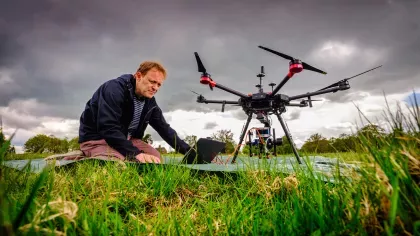
As a Field Technician in the Nature Unlocked team, Lindsay's job is to look after the science equipment in the landscape. This was a career change, following previous roles in marketing within the music and charity sectors, by going back to her roots in a Masters in Ecology. This involves changing lots of (very heavy) batteries, collecting data, and monitoring projects in progress in the field. On top of this, Lindsay has spent the last six months LiDAR scanning with Field Assistant Emilie, successfully measuring and tagging almost 900 trees within the Wakehurst Ecosystem Observatory (WEO) plots.
It is rewarding to be working in such a fascinating and important sector, and really is a dream job! Everyday feels like a blend of Challenge Anneka and the Crystal Maze (you may have to look up those TV shows if you are under 35!) – hunting through deep and hostile brambles for soil moisture sensors, scaling the muddy slopes of the SSSI whilst guarding the LiDAR Scanner with my life, and running a 50m tape measure in an exactly straight line, which is somehow harder than it sounds when surrounded by dense undergrowth.

Discover more about Nature Unlocked, and how our scientists are researching the benefits of biodiversity for people and plants.